Pattern Walkthrough – BurdaStyle Princess Seam Pencil Skirt

skirt1

I needed a sharp looking skirt that would work for winter, and I turned to some handwoven fabric I received as a present and this chic Burda Style Pattern.

Screen Shot 2013-02-20 at 3.35.02 PM

If you are interested in learning how to put a vent into a slim-cut dress or skirt, how to add a lining, or tips on working with handwoven fabrics, read on!

Continue reading

4 Comments

Filed under Clothes, Fabric, Pattern, Techniques

Modern Art Lessons – Fauvism

In today’s Lessons in Modern Art for the Modern Quilter, we mix it up with the “Wild Beasts!” … It’s Fauvism!

artbutton2

From about 1899 – 1908 a group of artists get even more bold with their color choices and the abstract nature of their art.  The compositions of these paintings were simpler to accommodate the unnatural and vivid colors.

Portrait of Madame Matisse. (The green line) - Henri Matisse - 1905

Portrait of Madame Matisse. (The green line) – Henri Matisse – 1905

There was no concern for if the colors were “realistic,” but rather if the paint choices represented the mood the artist was trying to convey.  Here, the colors of the paints were chosen for symbolic purposes and to stir emotion.

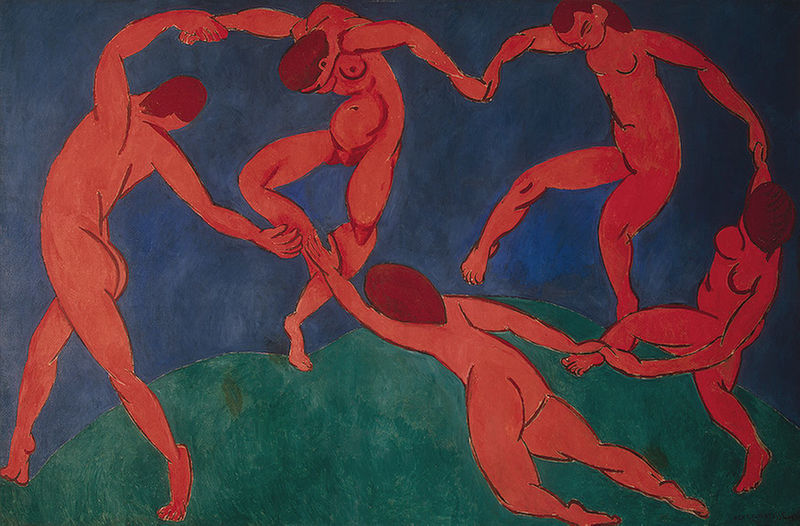
La danse (second version) - Henri Matisse - 1909 - 1910

La danse (second version) – Henri Matisse – 1909 – 1910

See the works of: Henri Matisse, André Derain

la_gerbe

La Gerbe – 1953 – Henri Matisse

I want to include these pieces here, eventhough they were not created until the 1940s and 50s.  In the 1940s Matisse became sick with cancer and had to undergo several surgeries.  Life in a wheelchair did not hinder his art, as Matisse began to create beautifully vivid paper-cutout pieces called gouaches découpés. 

I’ve always thought these pieces would make fantastic applique quilts  : )

The Fall of Icarus - Henri Matisse - 1943

The Fall of Icarus – Henri Matisse – 1943

I also wanted to include a picture of this brilliant quilt (blogged here – image used with permission) as an example of the power of color choice.  This is a beautiful blanket, made all the more stirring by it’s use of highly contrasting solid fabrics. 

 Although perhaps not unique to Modern Quilts, the saturated nature of solid fabrics common in Modern projects reflects the appreciation for vivid, bold colors found within the Fauvist movement.

Key Sources: theartstory.org and metmuseum.org

Leave a comment

Filed under Inspiration

Quilting an Owl Blanket

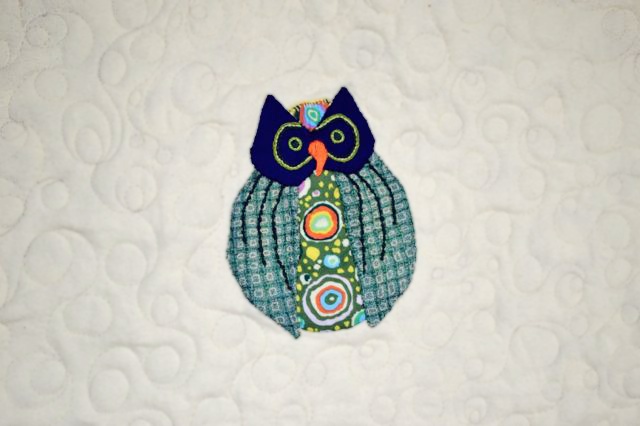
I didn’t get the best pictures of this project, but a friend of a friend hired me to quilt this adorable owl blanket…owls1


And I just wanted to share a close-up of these adorable hand-embroidered birds.

owls3

owl2

The background fabric is a fleece that is so comfy and soft.  The border fabric is the same as the backing and looks like a vintage sheet, but could be a recent purchase – I’m not sure.

I did loopy swirls and some detailing in the border.  Very cute blanket.

Leave a comment

Filed under Quilting

Archicoop! Quilt Top

Architextures by Carolyn Friedlander is the first line of fabric where I needed every.single.piece.  So wasn’t I a lucky duck to get a 1/2 yard bundle of the entire line for Christmas?! (Thanks, hubs!)

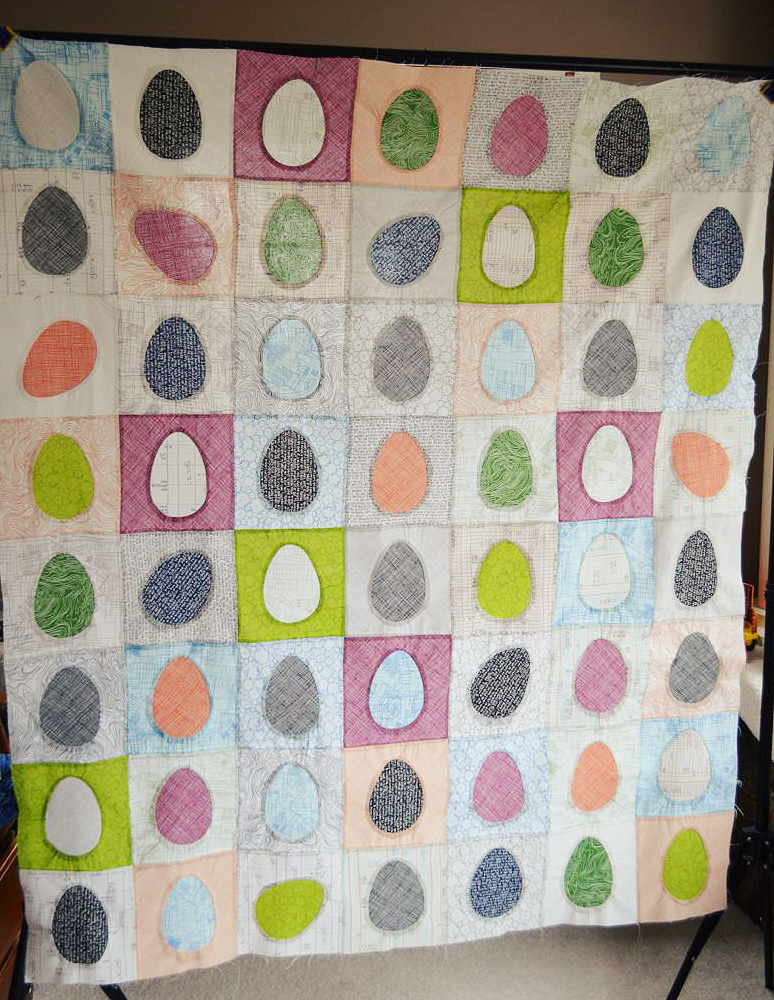
eggtop

The colors shout “Spring!” and ever since I saw Rossie’s Pebble Quilt, I’ve been hankering to make an egg blanket.

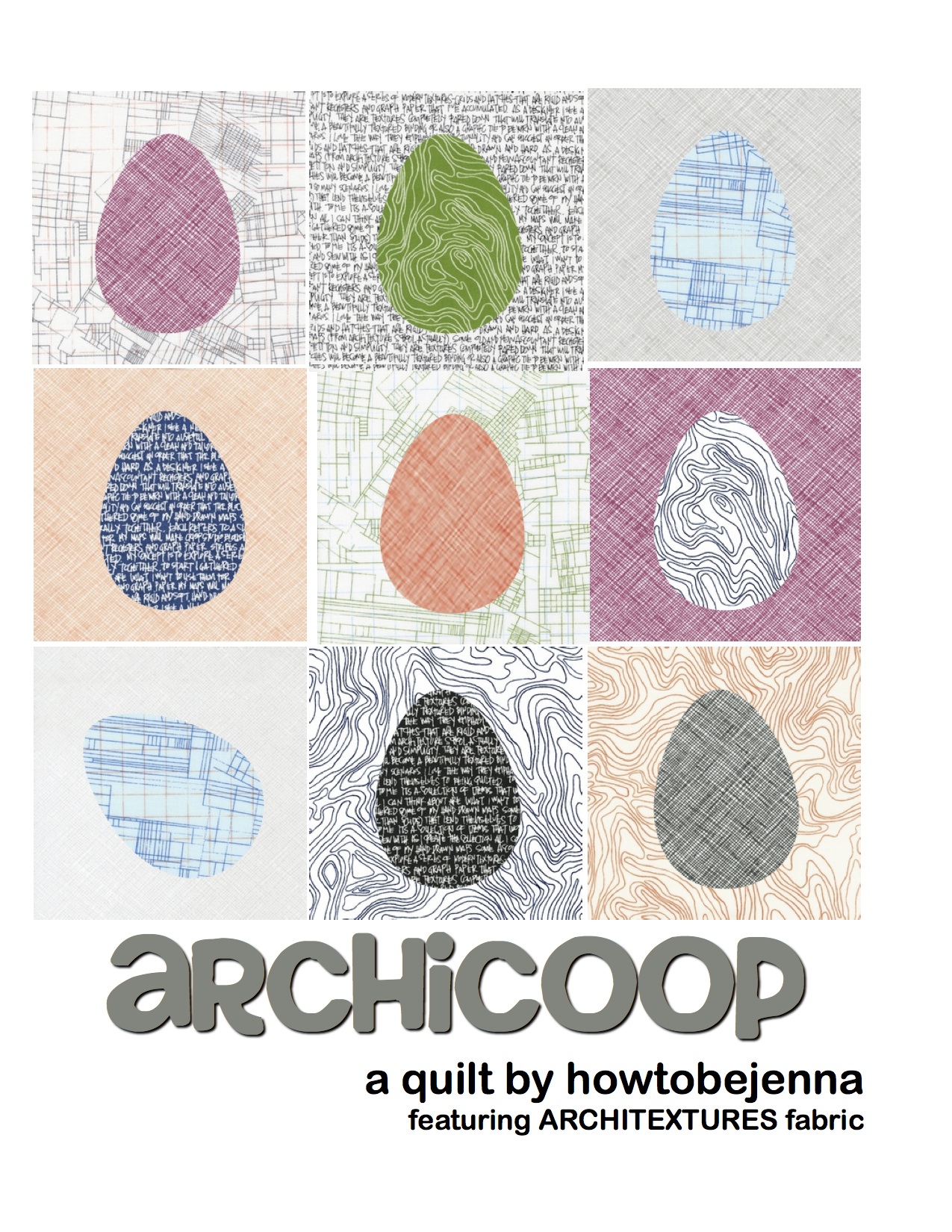
The pattern on this fabric is so geometric and linear, could it work for this design?  I needed to do a Photoshop mock-up!  (Check out this STUPID EASY tutorial for how to make something like this – I was shocked at the ease!)

archicoop

I looked good to me, so I went ahead and started making my egg blocks using Rossie’s Applique tutorial.  If you’ve seen the Famous Porthole Quilt by Lucie Summers I think this is the method!

eggtop2

I verged from Rossie’s tutorial in a couple of places.  For one, I didn’t trim the seam allowances before flipping the facing to the back.  I found that the facing would flip easier if I had more fabric to convince it to go with the flow.  And instead of top-stitching the layers together, I opted to pull out my fabric glue stick and do the Six Minute Circle method.    Just a couple dabs of water-soluble glue on the flipped fabric and stick it to your egg.  Then you sew along the same line from when you sewed your flipping fabric into place.  Essentially, you are sewing the seam allowance from the foreground piece to the egg background piece.  Go slow.  You can do it.

eggtopclose

No top-stitching! No hand-sewing!

After I sewed my facing to the egg fabric, I clipped the seam allowances.

eggtop3

Pretty quilt top!  Ready for backing and batting and basting and quilting and binding.

2 Comments

Filed under Fabric, Inspiration, Techniques, Tutorial

Modern Art Lessons – Arts and Crafts and Art Nouveau

artbutton2

As Impressionism and Post-Impressionism guided painters towards more abstract shapes and away from the glorification of the past, another movement was well underway.  The Arts and Crafts movement is dated from the 1860s – 1910.   As galleries and exhibitions continued to value the ornate and ostentatious, artisans started looking for ways to increase the beauty of a home with simple, purposeful, and well-crafted items.   Here materials mattered, and function mattered, and ornaments were secondary or viewed as unnecessary.   There was a reliance on bold colors and vivid patterns that were exciting without being over-decorated.

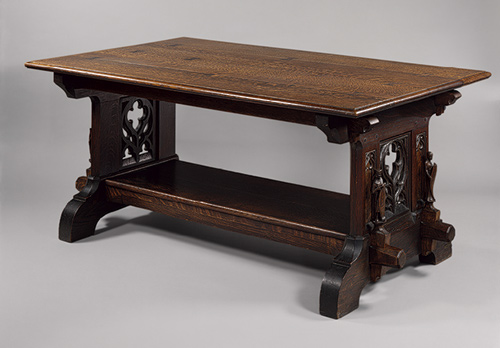
Library table, 1904William Lightfoot Price

Library table, 1904
William Lightfoot Price

The handicraft gained appreciation as a reaction against the over-mechanized, industrialized tones of the time.  One person creating one good from start to finish was rare in a world where factory lines assembled endless bits of products.

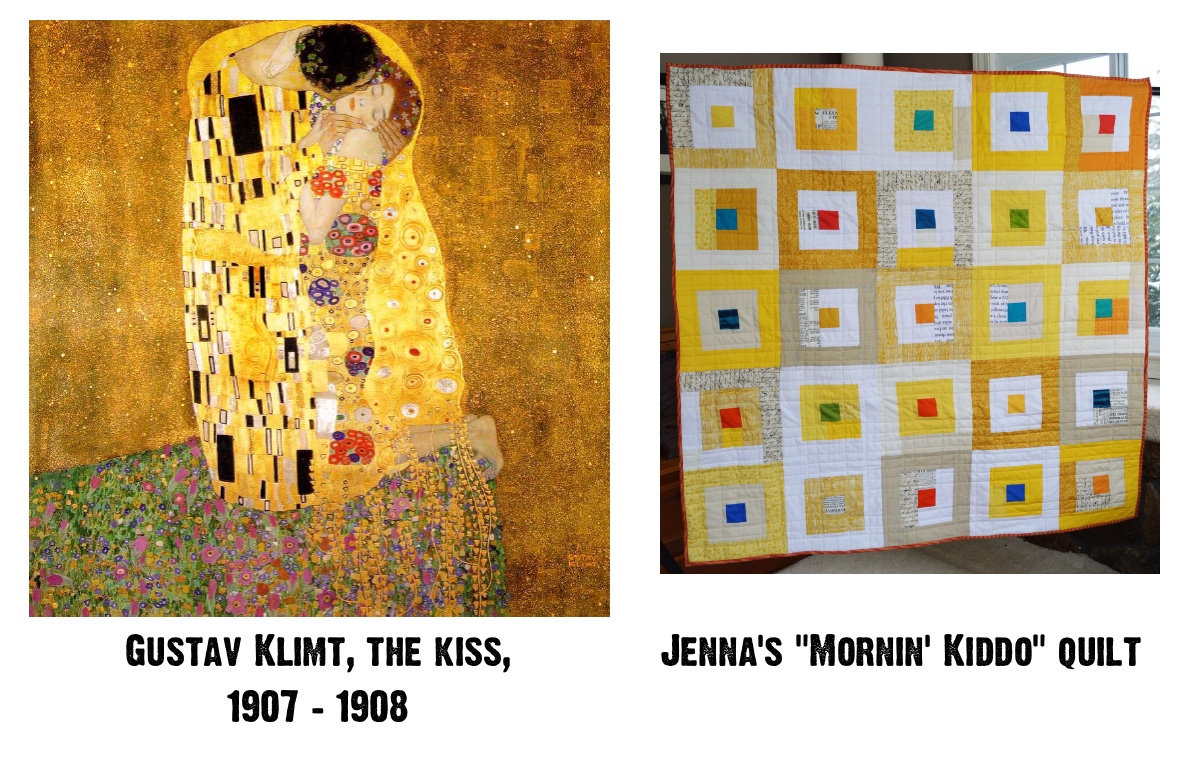
During this movement, we see a trend occurring in the world of painting during 1890 – 1905 that has been classified as “Art Nouveau.”  In these paintings we see artists using organic, flowing lines based on what they saw in nature, but creating this style with bold lines and shapes.

See the works of: Gustav Klimt

Rossie NouveauSee more of Rossie’s quilt here…

Jenna Nouveau

Look at these paintings and see how they are filled with modern quilting patterns.  With the wabi-sabi crosses, squares and triangles, certainly we can link our quilting movement to this era in history.

After learning more about the Arts and Crafts movement, I had greater appreciation for this quote from the Modern Quilt Guild:

“Modern quilts and quilters… make primarily functional rather than decorative quilts”

Indeed, our projects are not overly ornate.  Whereas many art-quilts may employ beading, wires, and glue as decoration, the Modern Quilt is meant to be comforting.  Even if hung on a wall as decoration, these blankets are made to warm a space (literally and figuratively).  There is a respect given to the “homey” nature of the quilt, rather than an undervaluing.  And certainly any quilter can appreciate the valuing of the individually created versus mass produced.   The admiration of the individual is especially evident in the world of modern quilting, as improvisational piecing and free-form design means more blankets are made without patterns and can therefore never be precisely recreated.

7 Comments

Filed under Inspiration

Modern Art Lessons – Post-Impressionism

artbutton2

The Post-Impressionists emerged in the 1880s and lasted primarily throughout the 1910s.  Can rebels rebel from the rebels?  Of course!  They do all the time and such was the case with the Post-Impressionists.

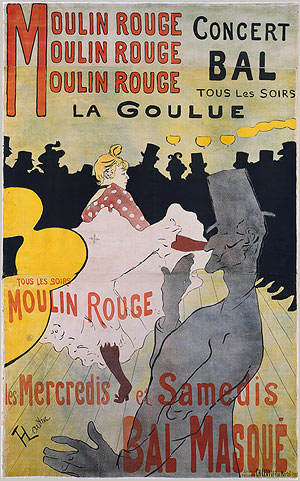
"Moulin Rouge: La Goulue" - 1891Henri de Toulouse-Lautrec

“Moulin Rouge: La Goulue” – 1891
Henri de Toulouse-Lautrec

The Post-Impressionists reacted against the “en plein air” naturalism of Impressionism, and wanted to explore the use of abstract form and pattern – relying less on nature and more on the personal experiences of the self.   A style emerged from this unofficial group of painters showcasing more saturated, simple colors and more abstract forms.

The popularity of the camera was a participating factor in the push towards abstract art.  In 1900 Kodak created the Brownie, an affordable box camera that could be easily operated. Now many people could own a camera and quickly create accurate portraits with a snapshot, but a painter had the infinity of imagination to represent personal emotions.

See the works of: Cézanne, Vincent van Gogh

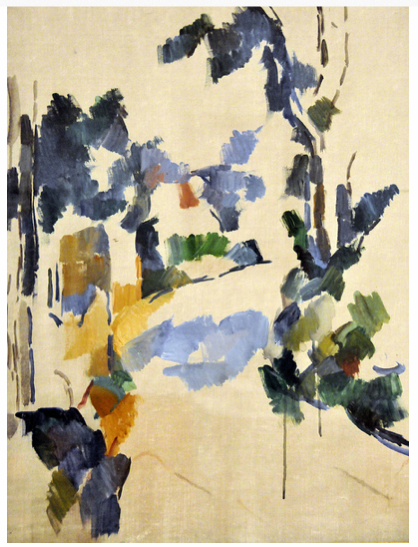
Paul Cezanne - Study of Trees, 1904

Paul Cézanne – Study of Trees, 1904

Looking at this painting, I definitely see a Modern Quilt.   The colors are more isolated from each other, there is space to breathe in the composition, and in a sense it appears to be just a glimpse of what we can imagine is a never-ending vision.   This painting goes beyond the canvas borders.

Is there a sense within the Modern Quilting community that, when looking at the precision of traditional quilts, there‘s a bit of “I can’t do that” or maybe “I could, but I don’t want to!”  That’s what comes to mind when I think of the inundation of portrait photography versus abstract art.  Maybe there’s a part of “I can’t compete, so why play” that leads to abandoning elaborately pieced, meticulously joined traditional quilts in favor or pursuing the loose nature of improvisational piecing, or large-scale piecing.  Moreover, I believe there’s a grander sense of “that’s been done – let’s try something new!”

Key Sources: theartstory.org, metmuseum.org, kodak.com

3 Comments

Filed under Inspiration

Modern Art Lessons – Impressionism

In today’s Lessons in Modern Art for the Modern Quilter, we’ll look at those who could be called the founders of the Modern Art movement, the Impressionists!

artbutton2

For context, here’s what most prestigious paintings looked like pre-Impressionism.  These are representations of Classicism, Neoclassicism, and Romanticism:

Molière - Nicolas Mignard (1658)

Molière – Nicolas Mignard (1658)

"Venus Induces Helen to Fall in Love with Paris" - Angelica Kauffmann - 1790

“Venus Induces Helen to Fall in Love with Paris” – Angelica Kauffmann – 1790

Eugène Delacroix, Death of Sardanapalus, 1827,

Eugène Delacroix, Death of Sardanapalus, 1827,

From the 1870s – 1890s there was a longing to break from the traditions imposed by academic artists.  The academics valued meticulous details and thought works must looked polished without any visibility of brushstrokes.

The Impressionists sought a new way to paint that would better reflect the “now,” rather than idolize historical moments, figures, or religious icons.  This was a time after great social upheaval (especially in France) and there was an emphasis on the new, modern way of life.

Impressionists looked to capture a moment on their paintings – the brush strokes were hurried and remained visible in the final product.  The traditionalists at the time thought their worked looked unfinished and were insulted. Another drastic change was the color pallet used by the Impressionists – light, airy colors were valued above the dark rich tones of traditional artists.

These new painters embracing this radical style found it very difficult to be accepted by art galleries.  Rejected by the prestigious art houses of the time, the Impressionists had to find their own ways to exhibit their work.

See the works of: Monet, Manet, Degas

Monet - "Westminster Bridge" - 1871

Monet – “Westminster Bridge” – 1871

Look at the use of “negative” light-colored space in this painting by Claude Monet, and the unbalanced composition of the docks.  The imprecision with how he depicted the boats in the water – there is a freedom from accuracy in favor of emotion.

Can we, as Modern Quilters, relate to this desire to step-away from traditional notions of quilting techniques and the traditional quilt composition?  When I think of traditional quilts, I see the meticulous piecing, and this is juxtaposed to the loose compositions of modern quilts.  The nature of repeated block patterned quilts can create a dark, rich tone to a traditional quilt whereas the use of sashing and negative space in modern quilts creates a lighter pallet.  And what can be said about reaching out to the blogosphere in order to find a community willing to embrace the experimentation of modern quilting?  Although traditional quilt guilds may not have “rejected” members for embracing a Modern style, there is comfort in finding a group of like-minded artists rather than remaining an outlier – for many of us this meant turning to the Internet and forming our own Modern Quilt Guilds.

Key Sources: theartstory.org and impressionism.org

4 Comments

Filed under Inspiration

Lessons in Modern Art for Modern Quilters – Introduction

What do we mean when we say we are “Modern” quilters?   Do we mean simply we are quilters who are making art that speaks to the “now”?  That we’re of-the-moment, or trendy?  Or are we identifying ourselves with the world of Modern Art?  What is “Modern Art?”

artbutton2

In my series “Lessons in Modern Art for Modern Quilters” I want to look at the history of this historical artistic movement, and relate the paintings (and sculptures) created during this time to our quilting community’s aesthetic.

I am not an art historian, and I am not an academic.  However, I felt a need to better understand Modern Art and am using this blog as a place where I can store my notes and analyze how “Modern Quilting” relates to Modernism as a whole.

My planned outline (subject to change) is to cover Impressionism (1870s) through Hard-Edge Painting (1960s) and the relevant styles that lie between.   I hope you enjoy this series as I have had immense pleasure looking to the past and being inspired by our Modernist predecessors!

Leave a comment

Filed under Uncategorized

A2MQG Spoonflower Quilt – My Rows

Jen from our quilt guild (who blogs HERE) surprised the A2MQG with a wonderful request from Spoonflower!  Pick a stack of our fabrics and make us a quilt that can be featured on the Spoonflower blog.

I grabbed these fabrics from Jen’s pile of pretties: Screen Shot 2013-01-29 at 10.36.39 AM

And I make two 60″ rows.  Everyone in the guild who wanted to participate was to make a 60″ row.  I wanted my rows to be quiet – to give the quilt a couple of places to breathe – and I wanted them to showcase these amazing fabrics.   So I fussy cut the arrow fletching and the stars (as best I could with the amount of fabric on hand) and spaced everything out with lots of Kona White sashing.

Screen Shot 2013-01-29 at 10.36.56 AM

Can’t wait to see how everything looks pieced together!  Thanks for organizing this, Jen, and to Spoonflower for the awesome idea!

2 Comments

Filed under A2MQG, Challenges, Fabric

Pattern Walkthrough – New Look #0299

button

Are you a beginner garment sewer?  Me too!  If you are interested in learning more about sewing from patterns, keep an eye out for more of my Pattern Walkthrough posts and we can learn together!

dress1

I have a couple of sewing resolutions for 2013… One of the biggest being I want to make myself some outfits.  I’m 6 feet tall with a LONG waist, so it’s difficult finding clothes that fit.

I saw this pattern on a model in JoAnn’s:

IMG_0566

Read on for a full pattern walkthrough…

Continue reading

8 Comments

Filed under Uncategorized