Category Archives: Techniques

Reverse Appliqued Snowflake Table Runner

Here is a reverse-appliqued table runner I made for my house for the winter.

Shown here on a bench because my table is a disaster.

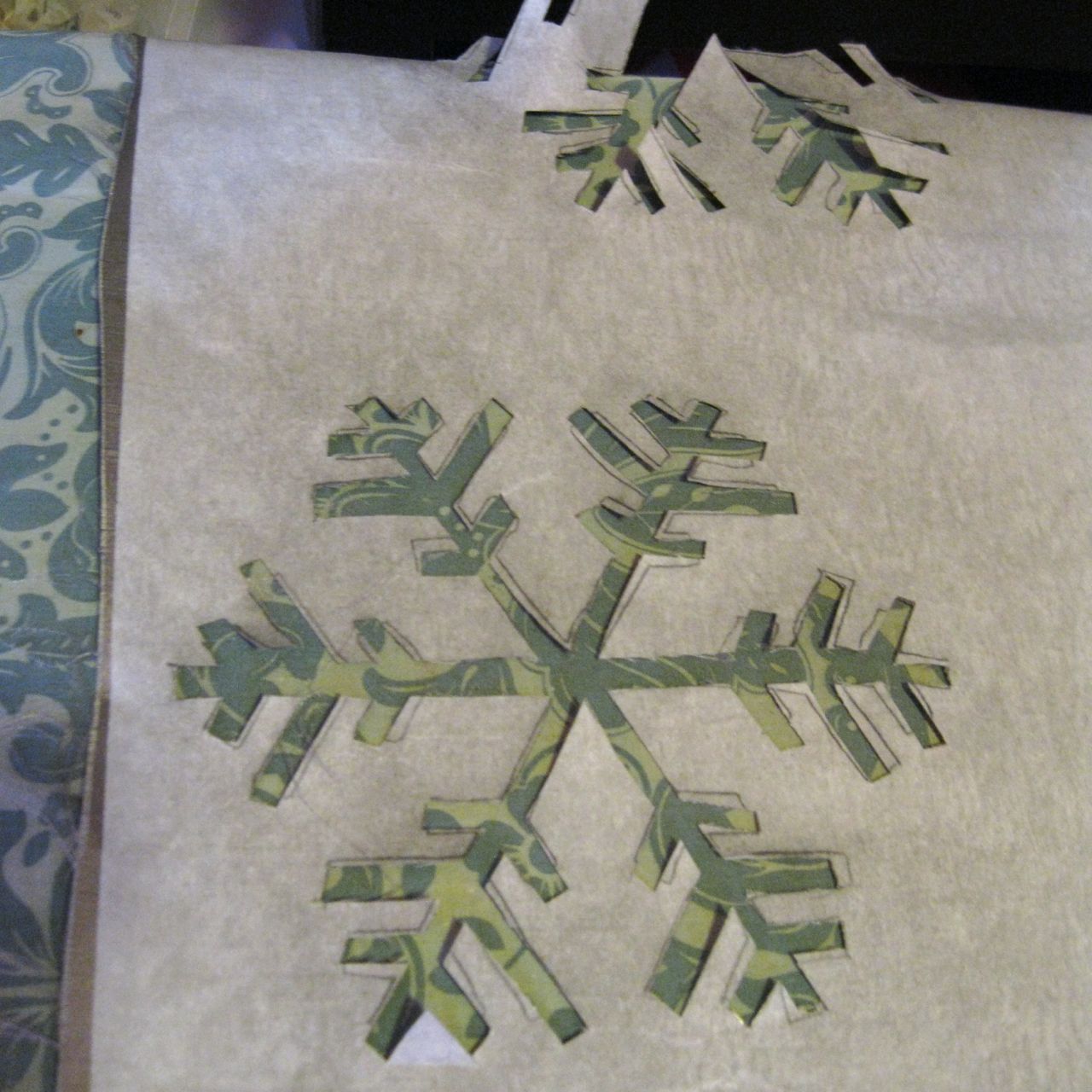
To make this start with a piece of your main fabric (mine was a duponi silk in grey/silver).  Back it with Wonder-Under (a double-sided fusible interfacing that is paper-backed so you can fuse one side at a time).  On the Wonder-Under, draw your snowflake shapes and then cut them out with sharp scissors.

Remove the paper backing.  Carefully place the main fabric on top of your accent fabric (both fabrics have right-side-up.  You are fusing the right side of the accent fabric to the back side of the main fabric).  Iron to fuse.

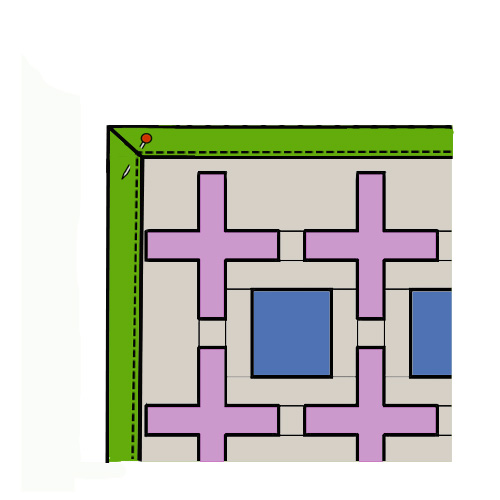
Next I sewed a backing fabric on to the runner.  I placed my backing fabric on top of the runner, right-sides of my backing fabric touching right-sides of the main fabric.  I sewed all the way around, leaving a gap to turn the runner right-side out.  I did not include batting, but you could if you wanted a thicker runner.

Once it was right-side out, I did a quilted stippling design.

Yay!  I have to say I really love this one.

1 Comment

Filed under Holiday, Quilting, Techniques, Tutorial

Tutorial: Square-In-A-Star-Block

This blog post relates to this tutorial I did for continuous seams…

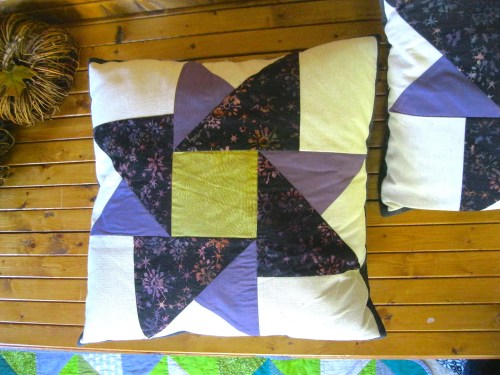
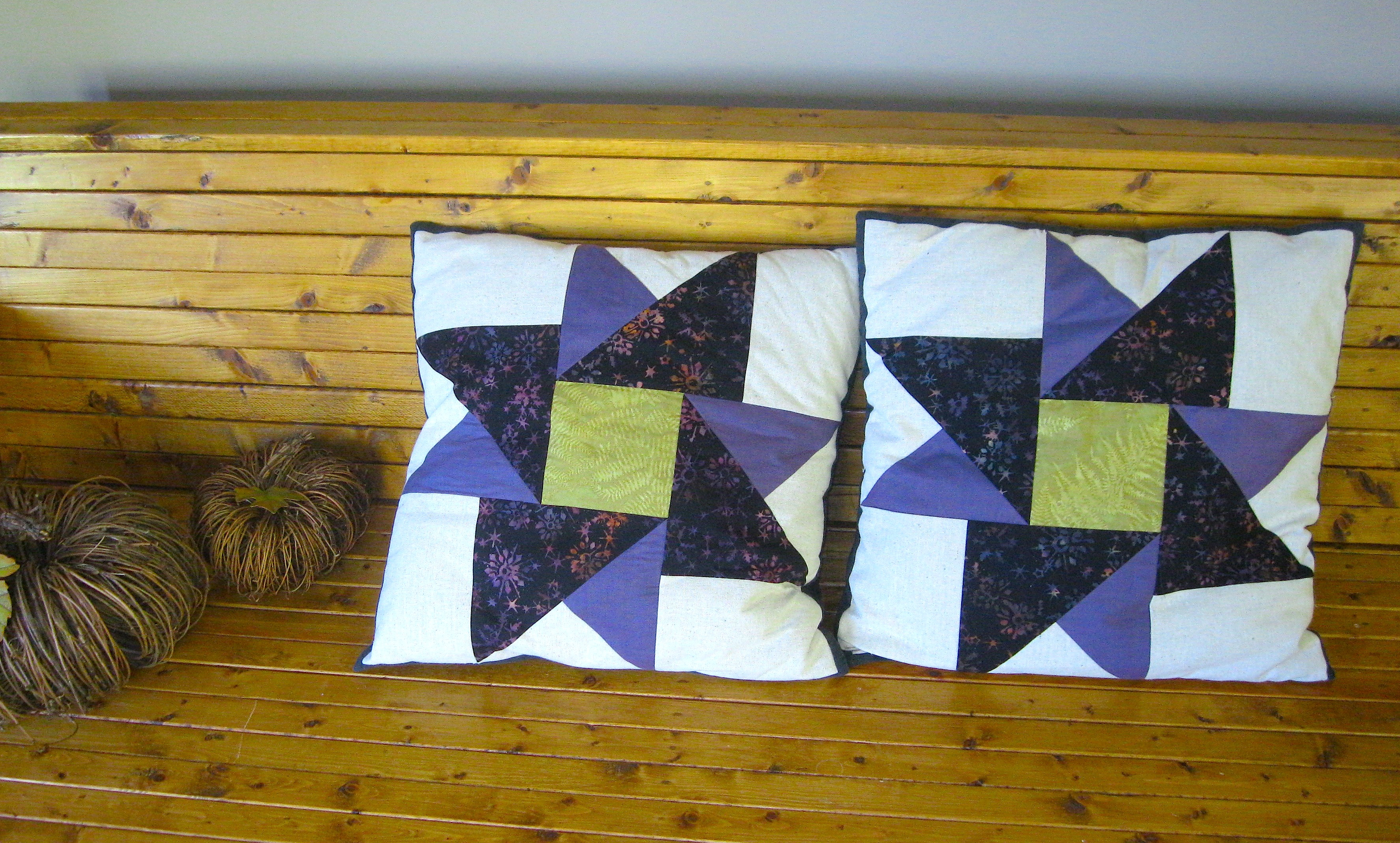
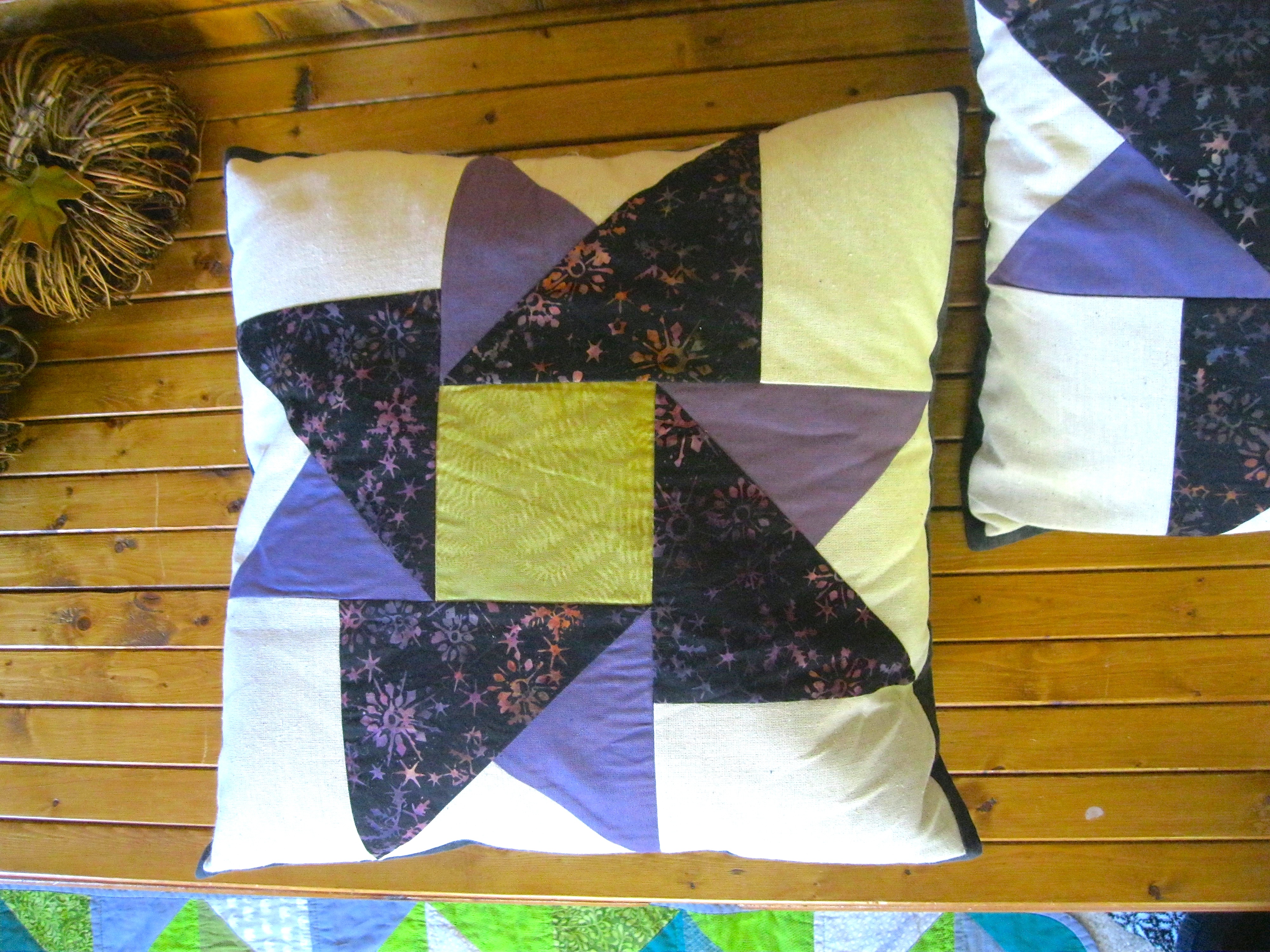
Look at these pillows I made!  These are for the Halloween season.
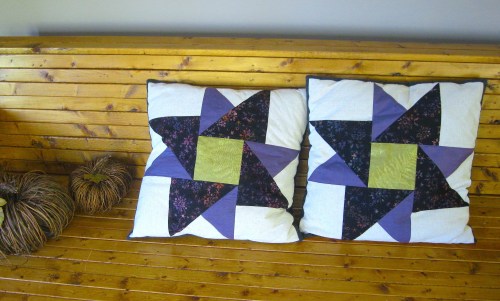
Not sure if this block has another name, but I’m calling it Square-in-a-Star!  Lyrical, poetic block-naming talent just flows through my veins, what can I say?

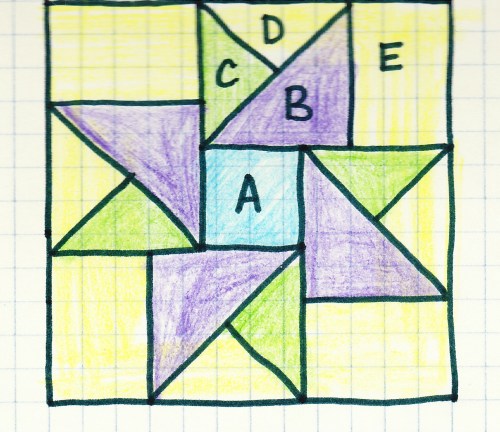
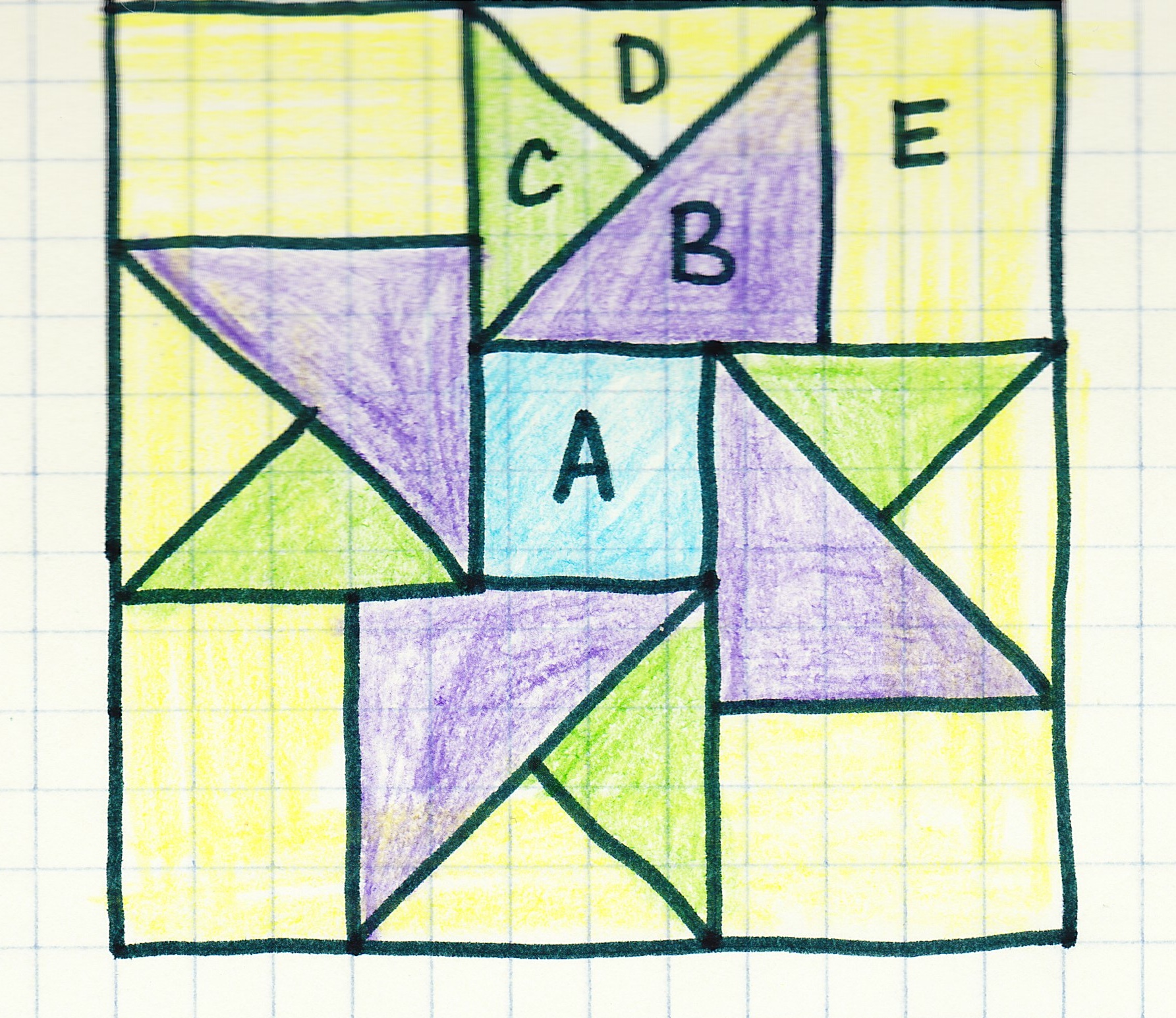
So here’s the block:
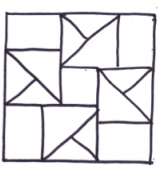
If you would like a 12inch finished block, here are the measurements for one block: (16inch block measurements below).

A – One square 3 1/2 inches (3 inches finished)

B – Cut two 5 3/8inch squares into 4 triangles.

C-  Cut one 5 3/4inch square into 4 triangles**

D – Cut one 5 3/4inch square into 4 triangles**

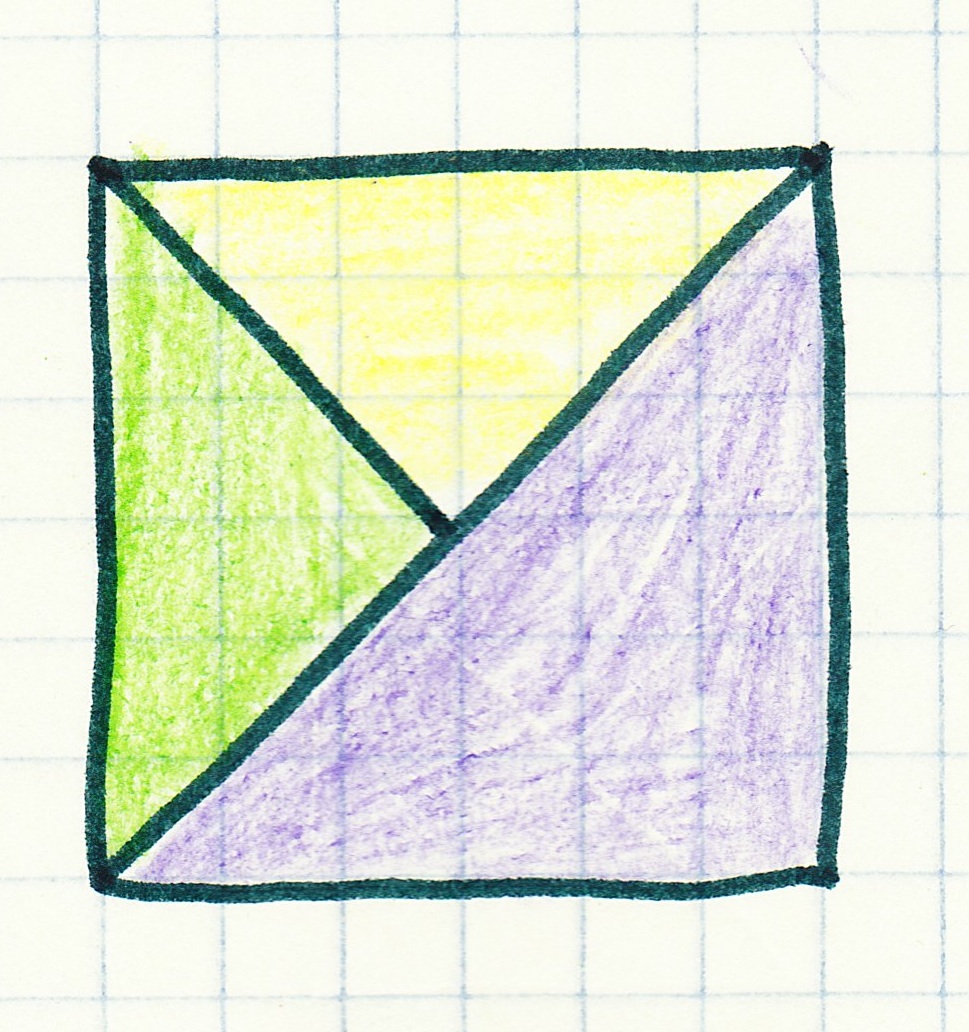
** Do not do a short cut for assembling quick QST (quarter square triangle) blocks.  It won’t work – I tried.  It won’t work because you will always need the C unit to be on ONE side of the D unit.  If you do the shortcut you’ll have mirror imaged blocks like a FOOL.  Just cut out the triangles and sew them together to make the two QSTs into one HST (half square triangle).

E – Four 3 1/2 x 5 1/2 inch rectangles in the same fabric as unit D.

And here are the measurements for a 16-inch finished sized block.

A – One square 4 1/2 inches (3 inches finished)

B – Cut two 6 7/8inch squares into 4 triangles.

C-  Cut one 7 1/4inch square into 4 triangles**

D – Cut one 4 1/2 x 6 1/2 inch square into 4 triangles**

** Do not do a short cut for assembling quick QST (quarter square triangle) blocks.  It won’t work – I tried.  It won’t work because you will always need the C unit to be on ONE side of the D unit.  If you do the shortcut you’ll have mirror imaged blocks like a FOOL.  Just cut out the triangles and sew them together to make the two QSTs into one HST (half square triangle).

E – Four 3 1/2 x 5 1/2 inch rectangles in the same fabric as unit D.

If you would like to adjust these measurements to make a different sized finished block, just remember… whatever finished size you would like this unit:

…you’ll need to take that number and add  1 1/4 for the QST units.  For example, if I’d like the square to finish to a 4 1/2 square, then I will need to cut make my C and D units from a (4 1/2 + 1 1/4) 5 3/4 inch square.

and you’ll need to add 7/8 inches for the HST units.  For example, if I’d like the square to finish to a 4 1/2 square, then I will need to cut make my B units from a (4 1/2 + 7/8) 5 3/8inch square.

If you’d like, you could make the A square be of the same fabric as the D and E units.  Just another option!

Assembly Instructions:

Sew triangles C and D together, always making sure you keep C on the same side of the D unit.  (Always to the left if you look at the block this way…)
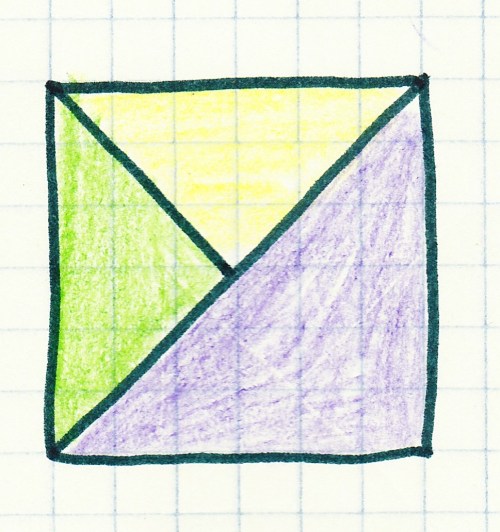
Sew the C/D HST unit the the B unit.

Sew E to the C/D/B unit.

To finish the rest of this block, refer to this blog post.  (Sorry to make you jump posts, but it’s just easiest this way.  I’m not digging for blog hits or anything, I don’t make money off of this blog).

There you go, dears!  Enjoy!

Leave a comment

Filed under Techniques, Tutorial

Tutorial: Right-Angle Seams Cheater

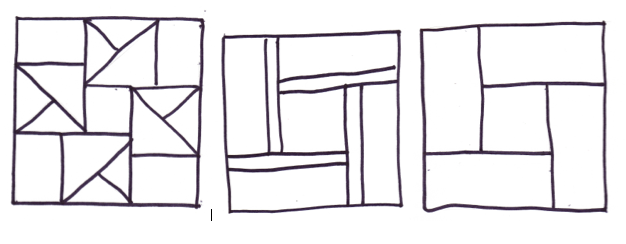
Take a look at these block patterns:

Looks like you’d have to do a Right-Angle seam, doesn’t it? You don’t!

Here’s how you can make these blocks (and many more) with continuous, straight seams.

Continuous Seam Tutorial:

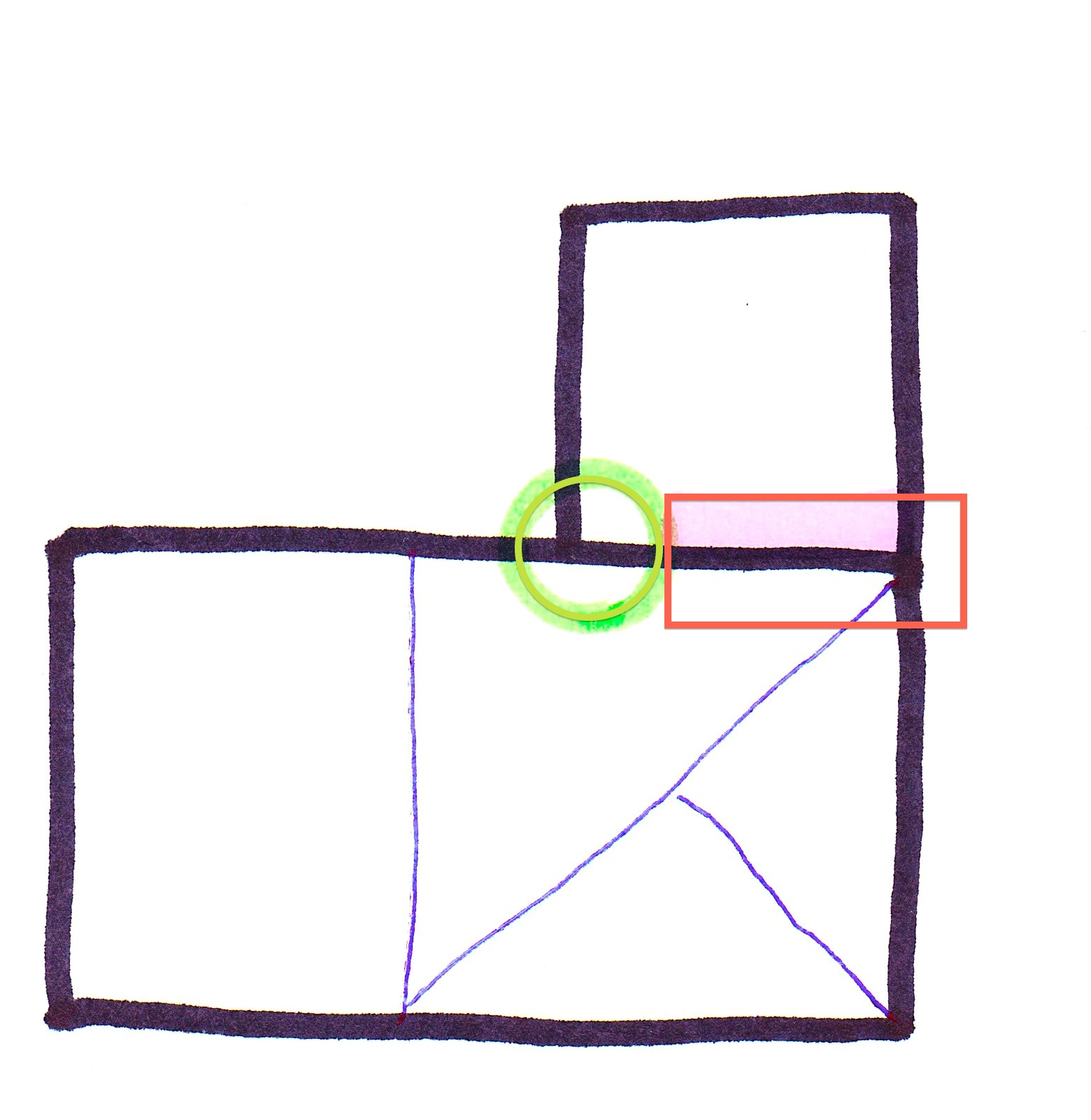
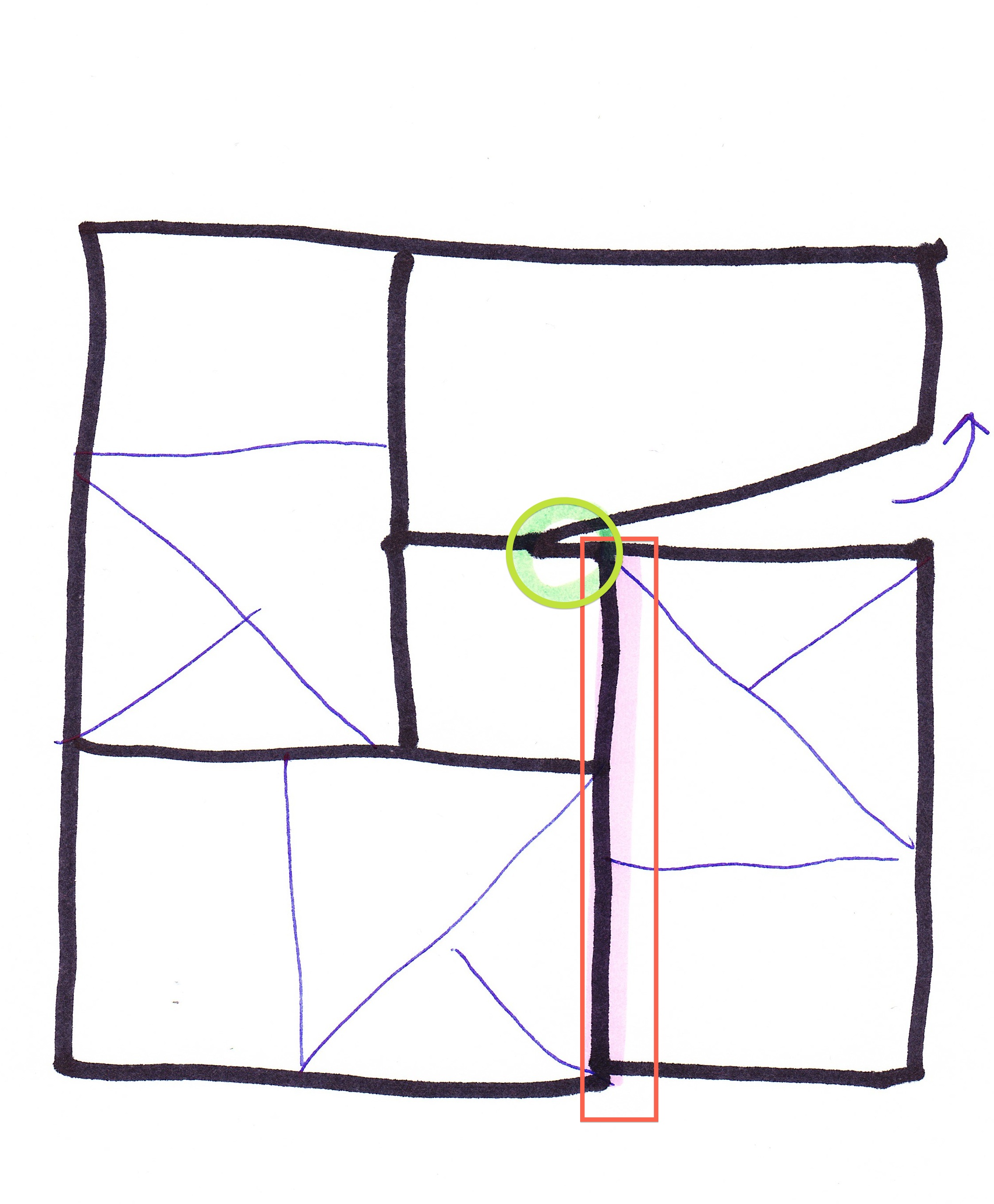
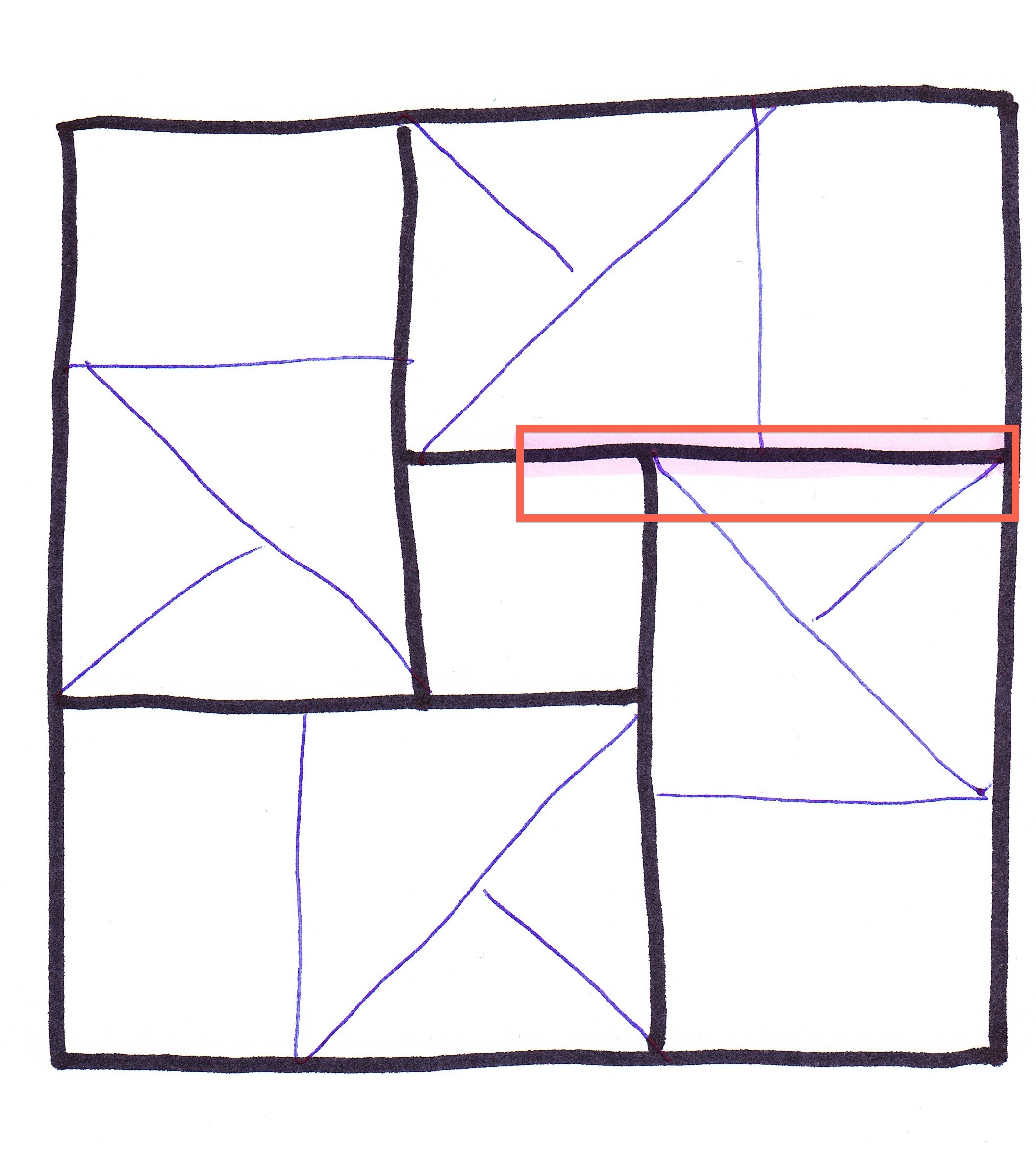
In the images below I highlight the seams you need to sew with a red rectangle.   To clarify, you sew these blocks by placing the units on top of each other, right sides together, then open and press the seam as you like (whether that be by pressing the seams open or in one consistent direction).

Step One: Sew your center square unit to a rectangle unit, but not the whole way. Sew only the length of the red rectangle, but not inside the green circle. The key here is to sew more than 1/4inch long, and to leave more than 1/4inch of free space.

Step Two: Sew on the next rectangle unit, this time for the whole length (highlighted by the red rectangle). This is similar to sewing log cabin blocks, if you're familiar.

Step Three: Sew on the next rectangle, again for the entire length (highlighted by the red rectangle)

Step Four: To sew on the next rectangle unit, you'll have to scootch the first rectangle unit you attached out of the way. This will be easy to do because you did not sew within the green circle back in Step One. Attach the rectangle unit.

Step Five: You now need to finish the seam you started in Step One. Fold the first rectangle unit over the square, right sides together, and finish the seam you started, making sure to reinforce the start of this new seam by going backwards and forwards first. You're done!

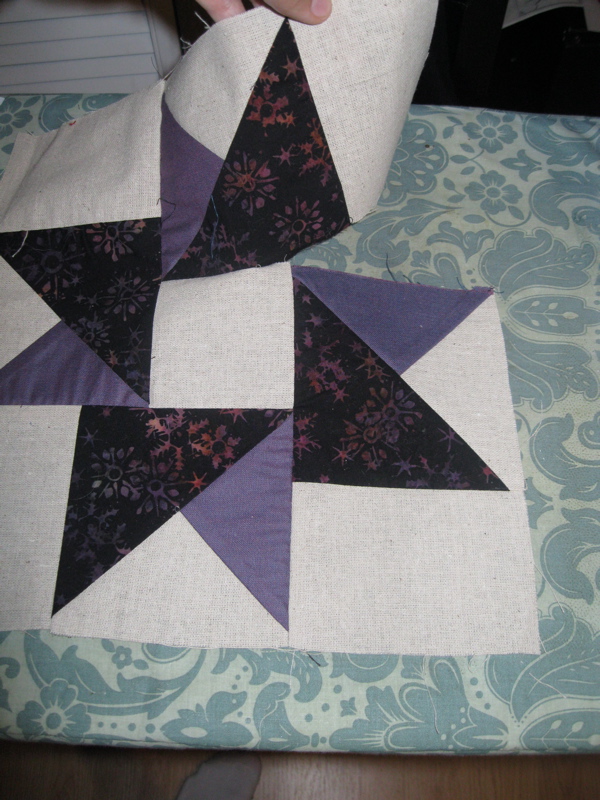
Here are some pictures showing that last step…

Ready to continue this seam!

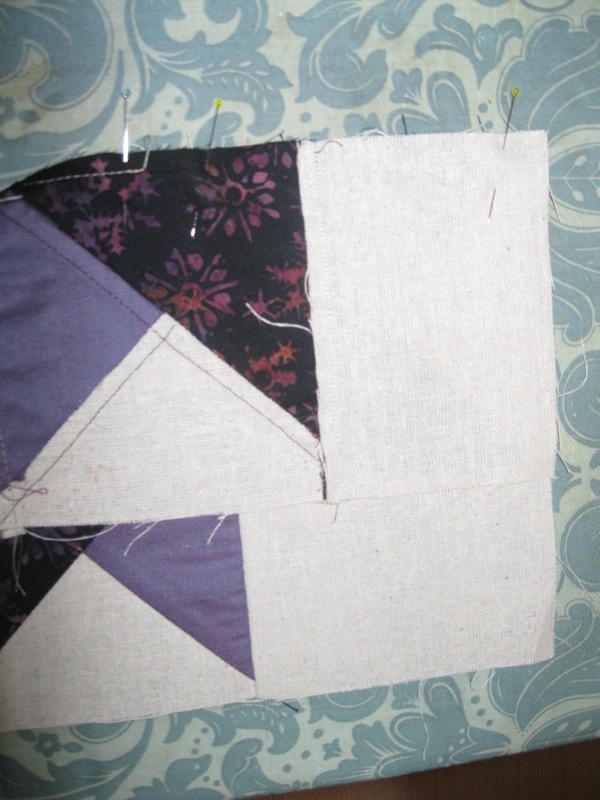
Can you see the white thread? That's the seam I started in Step One. I am pinning my units together and am going to sew, continuing that first seam to the edge of the unit.

I did it!

Do you like the block featured above?  I will do another post soon with some more tips on assembling that block.  Stay tuned!

3 Comments

Filed under Techniques, Tutorial

Cog + Wheel Quilt – Part Two

Read here for Part One.

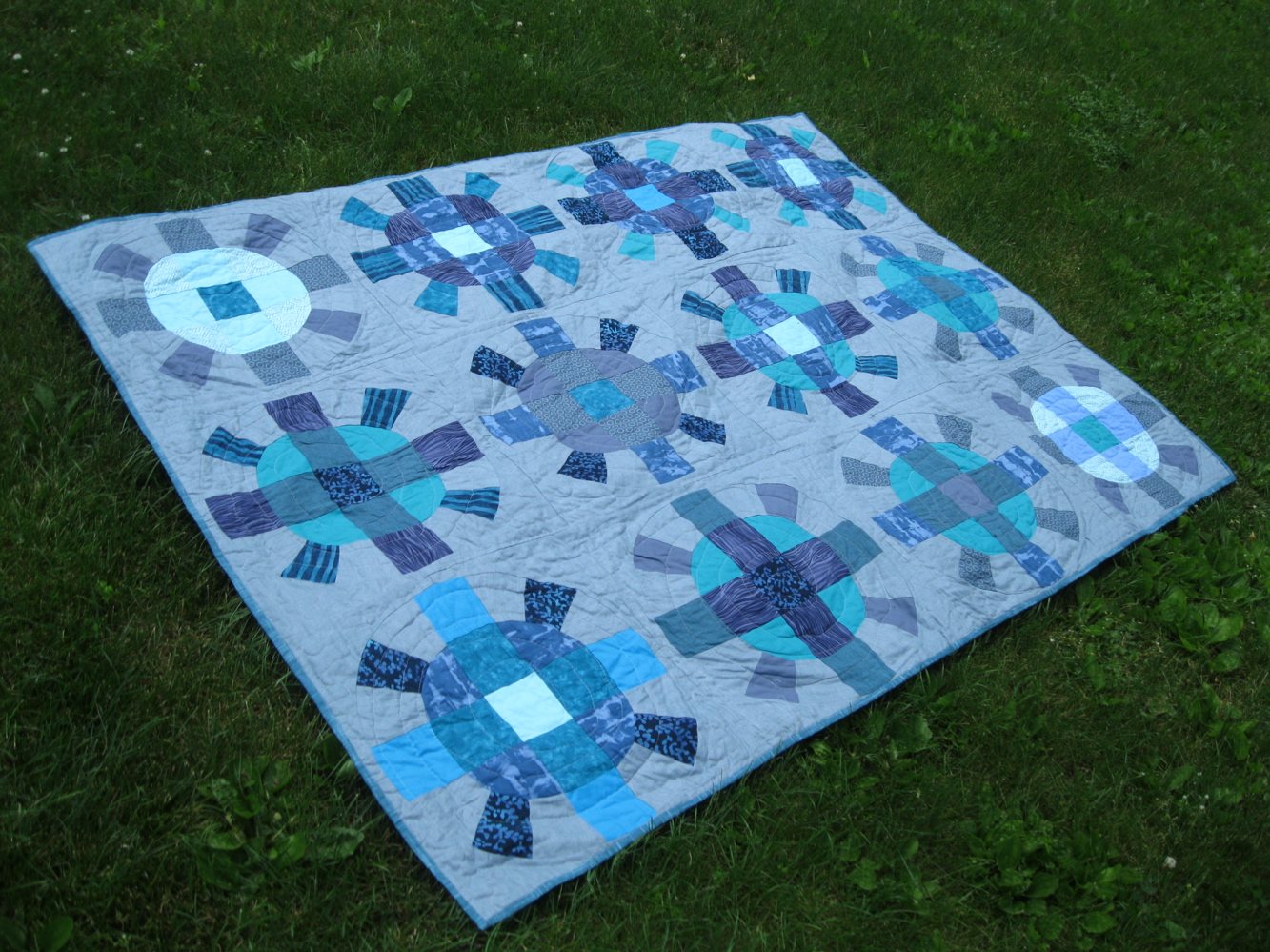
It was just in the nick of time (we set an arbitrary deadline of Saturday, June 12) but I finished Lloyd’s quilt and slapped it on his freshly assembled Big Boy Bed in time for the inauguration!

This is my version of the Denyse Schmidt Cog + Wheel Quilt.

I had a bit of a hard time getting my blocks to lay flat, due solely to my imperfect curved piecing.  However, I starched the heck out of each block and that helped considerably.

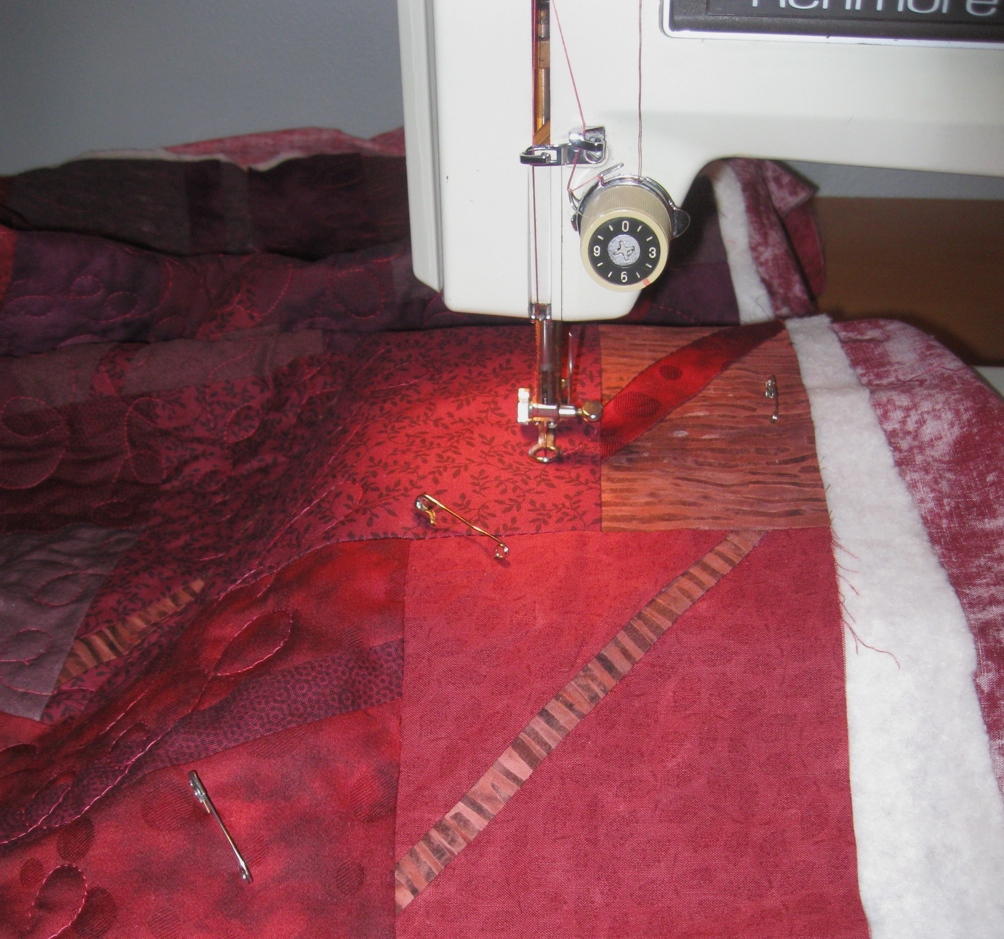
Then I did something a little crafty… I was so worried about basting this blanket because it was a little warped and wonky – so what I did was baste just the top to some batting, and did half of the quilting without the backing attached.  Then I attached the back and quilted the rest of it and everything worked out great!  I’m not sure how much it helped to do half of the quilting without the back, but in my head it saved me from worrying about bunching the backing and allowed me to just worry about the top.

The backing was made out of Castle Peeps (which I got from Pink Castle Fabrics).

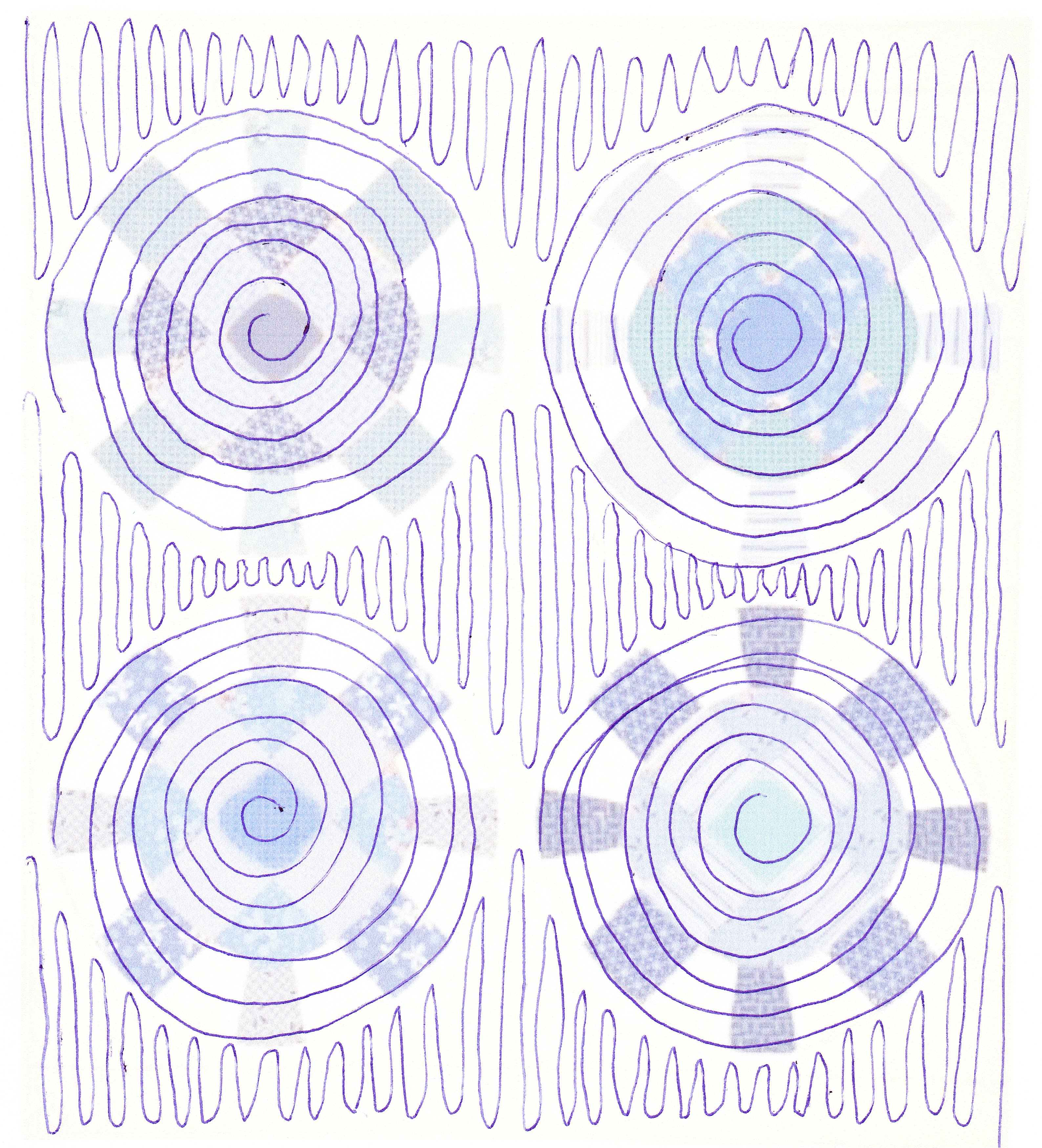
The pattern called for a more sophisticated concentric circle quilting pattern, but I like my design.

For one, it was a lot easier to do on my machine with my free-motion foot.  For another, it looks a little more scribbly, which is nice for a kid’s quilt.

Lloyd loves his big boy bed and transitioned to it perfectly.  Slept the whole night through without a peep!  For safety we got this inflatable bumper you slide under the fitted sheet – works like a charm!  He can’t get out, which is just the way we want it ; )

Thanks for looking!

3 Comments

Filed under Fabric, Quilting, Techniques

Nice Cans!

My quilting life has improved dramatically thanks to the purchase of these two beautiful cans:

Why had I never used spray starch before?!  When I was ironing out the quilt-top for Baby Henry’s quilt I noticed that some of the older fabrics I had used were stretching a little bit as I pressed.  I had pre-washed everything, but sometimes cheapo and old fabrics stretch – thems the breaks.   I had heard that spraying starch after ironing would help stabilize the quilt-top and make my life easier.  Boy, did it!  Another benefit is that I had this quilt-top draped over the back of a door for over 10 days, waiting to have a backing made and become a quilt-sandwich.  It stayed crisp and pressed for that entire time!

By the time I was ready to baste Henry’s quilt I had read THIS WONDERFUL HOW-TO by Film in the Fridge extolling the benefits of 505 basting spray.   For a long time I had heard spray-basters wonder: what the heck are pin-basters doing?!  Now I am one of those spray-basters!   NO MORE PINS FOR ME.

Pin-basting sucks, and I suck at it.  I have never NOT stretched my fabric too far while attempting to create a perfect flat sandwich and I ALWAYS have to readjust my basting at least 10 times before finishing quilting a blanket.   I’ve had great success in my short machine-quilting life, but not for lack of elbow grease and curse words during the basting and re-basting processes.

You guys – what would have taken me seriously close to 90 minutes (not including the time to clean the kitchen floor properly and move the furniture around in there so I have enough room) and a LOT of swearing, not to mention sore knees and lower back took me MAYBE only 20 MINUTES from absolute “hey-maybe-I-should-baste” start to finish.

Read the tutorial for a guide on how to do it.   The only other note I have to offer is in regards to spray-off.  Elizabeth does not put anything under her batting because she has a room with a carpet she doesn’t care about (and she’s never noticed the carpet being sticky or affected by the spray).  I am not lucky enough to have such a room, so I laid a large fleece blanket I have down on my carpet, and then put the batting on top of it.  I then ironed my batting so it was super flat.  Then I placed my quilt-top on top of the batting and ironed the top.  I let the quilt cool-down (the can of 505 says the fumes are flammable enough times to make me a little paranoid), and then I started the spraying process as Elizabeth describes.   After I was done basting my quilt, I throw my fleece blanket in the wash!  No worries about sticky carpets – just in case.

I’ve only used the spray baste on baby quilts.  I’ve read people who regularly make queen-size quilts that the spray basting still holds up perfectly for larger blankets.  I know I will definitely be trying it as a first-resort on all future quilting projects I have planned!

One last note: although I haven’t read of any problems about starch or spray baste gumming needles, I have heard some people be concerned about giving sprayed blankets to babies.   Simple: just wash your blankets before gifting them!  The sprays are both water-soluble.

4 Comments

Filed under Techniques

HST Coloring Pages

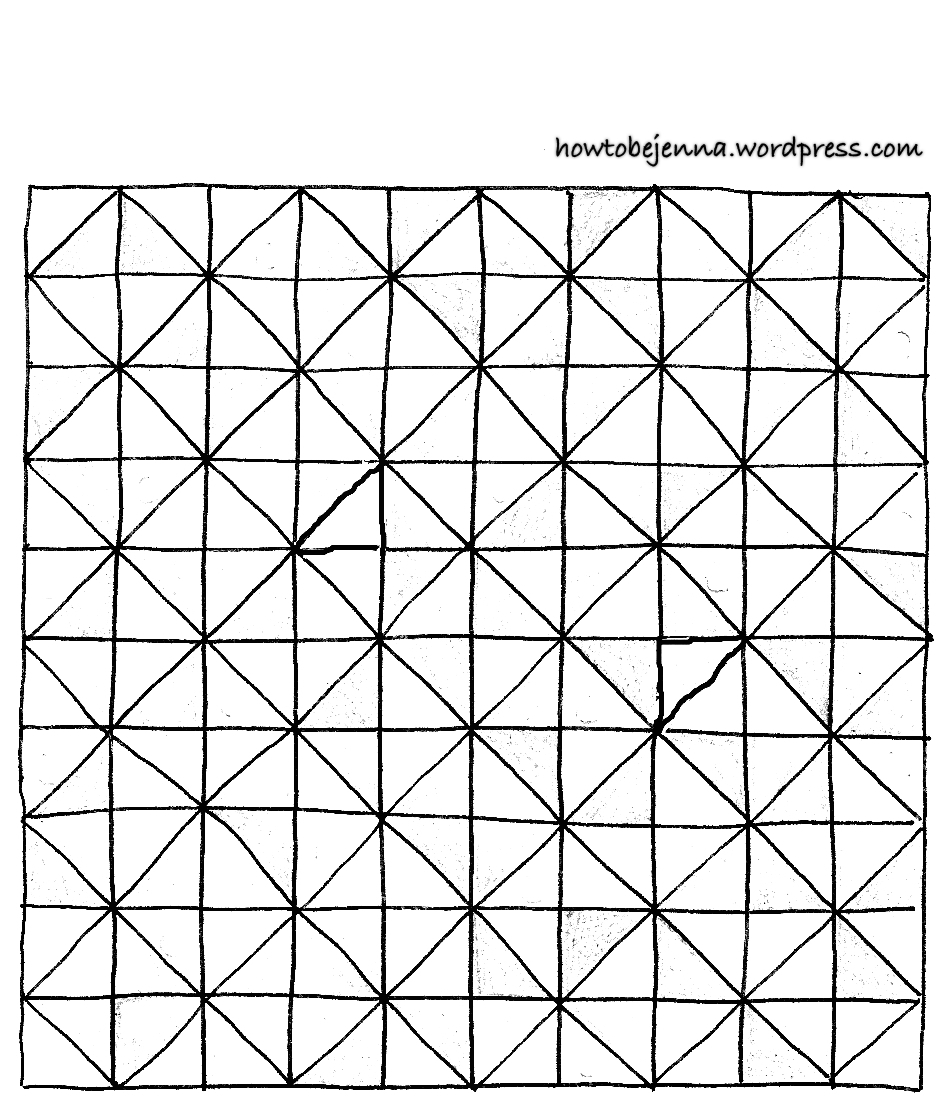
Hello everybody!  I’m currently working on two HST (Half-Square Triangle) Quilts and am loving it!  They come together fast and there are so many possibilities for design.  Anyway, part of my planning has been to sketch-out my layouts and color them in.  I don’t follow my drawings completely during assembly, but it’s a nice test to see if my fabric color choices are going to jive and to give me an idea for how many pieces of each color fabric I’m going to need.

So if you’d like to use any of these coloring pages to plan your own HST quilts, feel free!  They’re not perfect, but if you want them, just click on any of the images below and you should be able to drag them onto your desktop or left-click “save as” them onto your computer.  Let me know if you have any problems!  If you post your colorings on your blog, please don’t crop-out the little “howtobejenna” tag I’ve included on the drawings.   Other than that, these are yours!  Thanks!

Leave a comment

Filed under Quilting, Techniques

Old Post…

This is the old post for back-to-front binding.  This tutorial has been updated and can be found HERE! 

binding-6

4 Comments

Filed under Quilting, Techniques

Lucky Me!

I’m so thankful to be such a lucky gal.  I’ve got a wonderful husband, an incredible toddler, a healthy baby on the way (6 more weeks to go – yikes!), a good job that allows me to work from home, great family, friends, and a house.

Lucky me!  And that’s the name of this pillow that is one of my two entries into the Great SMS Pillow Contest! (My other is the V-shaped Marca-Relli pillow):

Click CONTINUE READING or scroll down to see more pictures, as well as photos of its mate, links to the pattern, and some tips on assembly.

Continue reading

Leave a comment

Filed under Challenges, Quilting, Techniques

Batiks – Lessons in Free Motion Quilting

I don’t see a lot of modern quilts being made with batik fabrics (patterned, dyed fabric where parts of the fabric not intended to be dyed are covered with removable wax).   It’s too bad because they are crazy beautiful.   Take a look at just a couple from Robert Kaufman’s line of artisan batiks:

Anyway – I love batiks.  I incorporated a couple of batik fabrics in my Project Modern Challenge 2 quilt, and I’m so happy to tell you that I machine quilted it this weekend.

Everything was going great until it wasn’t.   Randomly I’d reach a region in my quilt where I’d skip a billion stitches, over and over again.  Why?!  Then all of a sudden I realized what was the matter.  My machine hated this one batik fabric!  (I actually yelled “he hates these cans!” during my eureka moment).

BLERG!  One thing I did NOT know about batiks is that they sometimes get sad when you machine quilt them.  The fabrics are incredibly tightly woven.  If you use a regular universal needle, chances are you may experience skipped stitches, especially when free-motion quilting.  The needle is too dull/big and it’s being forced to break the batik threads rather than scootch them aside for quilting. I have not had this experience on previous projects, but boy was there one batik fabric that gave me the business this weekend.

Instead of stopping everything and researching the problem, I first practiced avoidance and quilted around the evil fabric.  Then when it could no longer be postponed I went back to the region, set my needle, and absolutely floored it – reducing the stitch length dramatically until the area was reasonably quilted.   It looks fine.

Now that it’s done and everything looks good, I’ve taken a couple of deep breaths and researched the matter.  So, if you are ever experiencing trouble free-motion quilting on batik fabrics (and your machine is clean and you’ve tried re-threading your bobbin and monkeying with your tension) the Internet says that these tricks might help:

1. Use a brand-new top-stitching grade needle.

2. Use Sewer’s Aid on your thread.

3. Lift up your feed dogs (gasp!), but continue free-motioning.

Also – always pre-wash batiks.  I pre-washed all of my fabrics, but it wasn’t enough to help with this one particular swatch.  That being said, if I hadn’t pre-washed all of them maybe I would have experienced even MORE trouble!

I hope that helps someone out there who was smart enough to stop what they were doing and research solutions before resorting to aggressive guerilla quilting tactics… although they did work fine for me in the end  ; P

5 Comments

Filed under Challenges, Quilting, Techniques

Franken-batting

I first heard the phrase “Franken-batting” a few days ago while reading the “Goddess in Progress” blog. Liz was zig-zag sewing tons of batting scraps together to make a batting big enough for her quilt.   This is something I do all the time, especially for small projects like quilted pillow covers.

Cara wrote a great point in the comments of that post mentioning that this isn’t the best method to use if you have a primarily white quilt-top.  Apparently in her experience, the zigzags would slightly show through the top.   I’ve never had that experience, but I’ve also never had a primarily white quilt-top!  Just thought I’d re-post that message in case anyone would benefit over here at howtobejenna.

Anyway, I’ve made the batting monsters for my Marca-Relli pillow covers, and for my Project Modern Challenge 2 red quilt.   I really hope I can finish my pillows this weekend, assemble my red quilt backing, and if I’m really being productive, maybe even baste it!   That’s a tall order considering I’m moving like molasses.   There’s so much to get done before baby #2 comes along, just some-odd 8 weeks away!  Yeep!

Leave a comment

Filed under Quilting, Techniques